 AgenticRoboRLBringing Coding-Agent Post-Training to Agentic Robotics
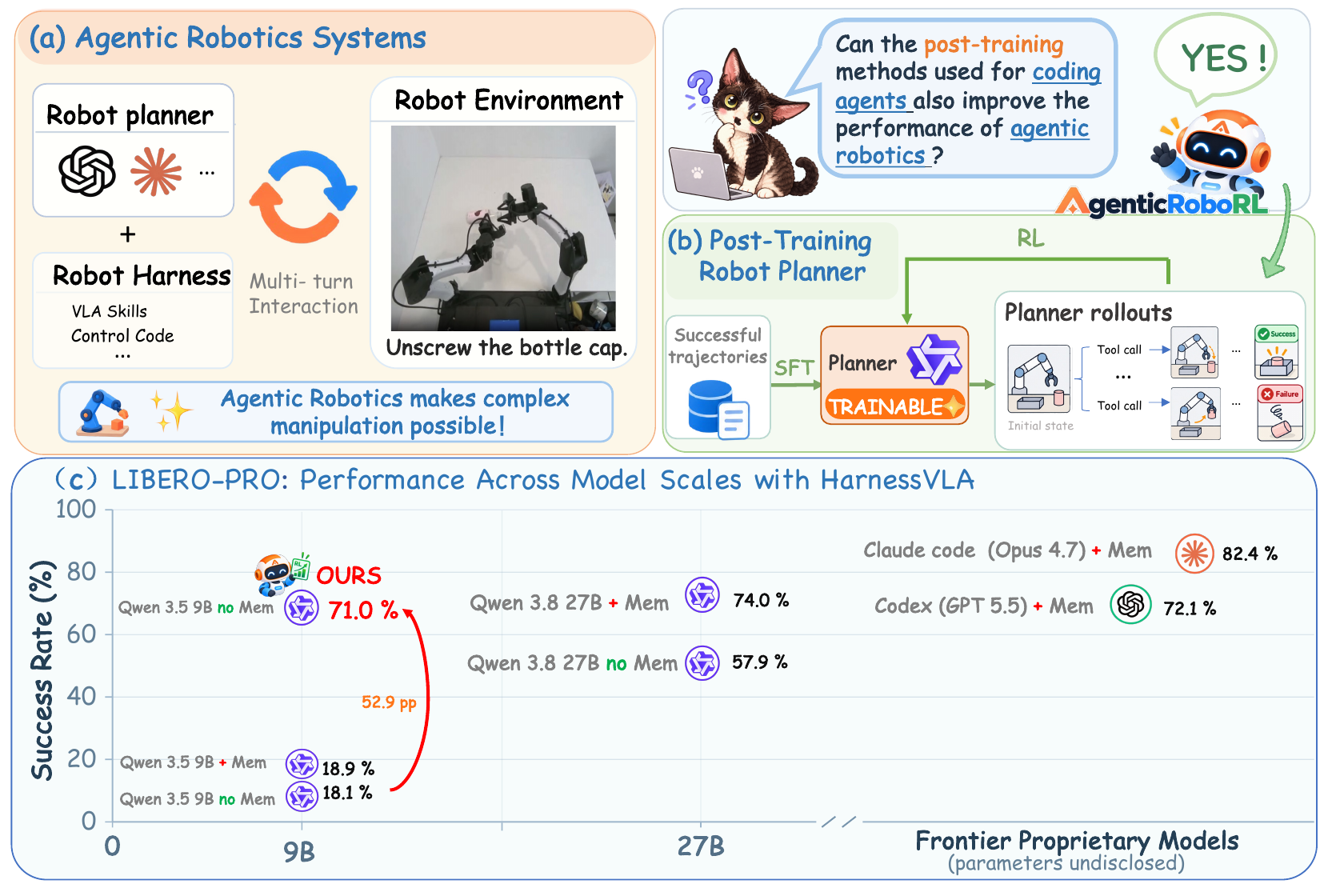
AgenticRoboRL is the first general post-training framework for agentic robotics systems.
- No external memory
- Multi-turn RL
- One pipeline for ANY harness
- 18.1%+52.971.0%
- LIBERO-PRO
original 9B → post-trained 9B, no external memory - 19.2%+53.072.2%
- LIBERO-Plus
same two checkpoints, no extra training
Training pipeline
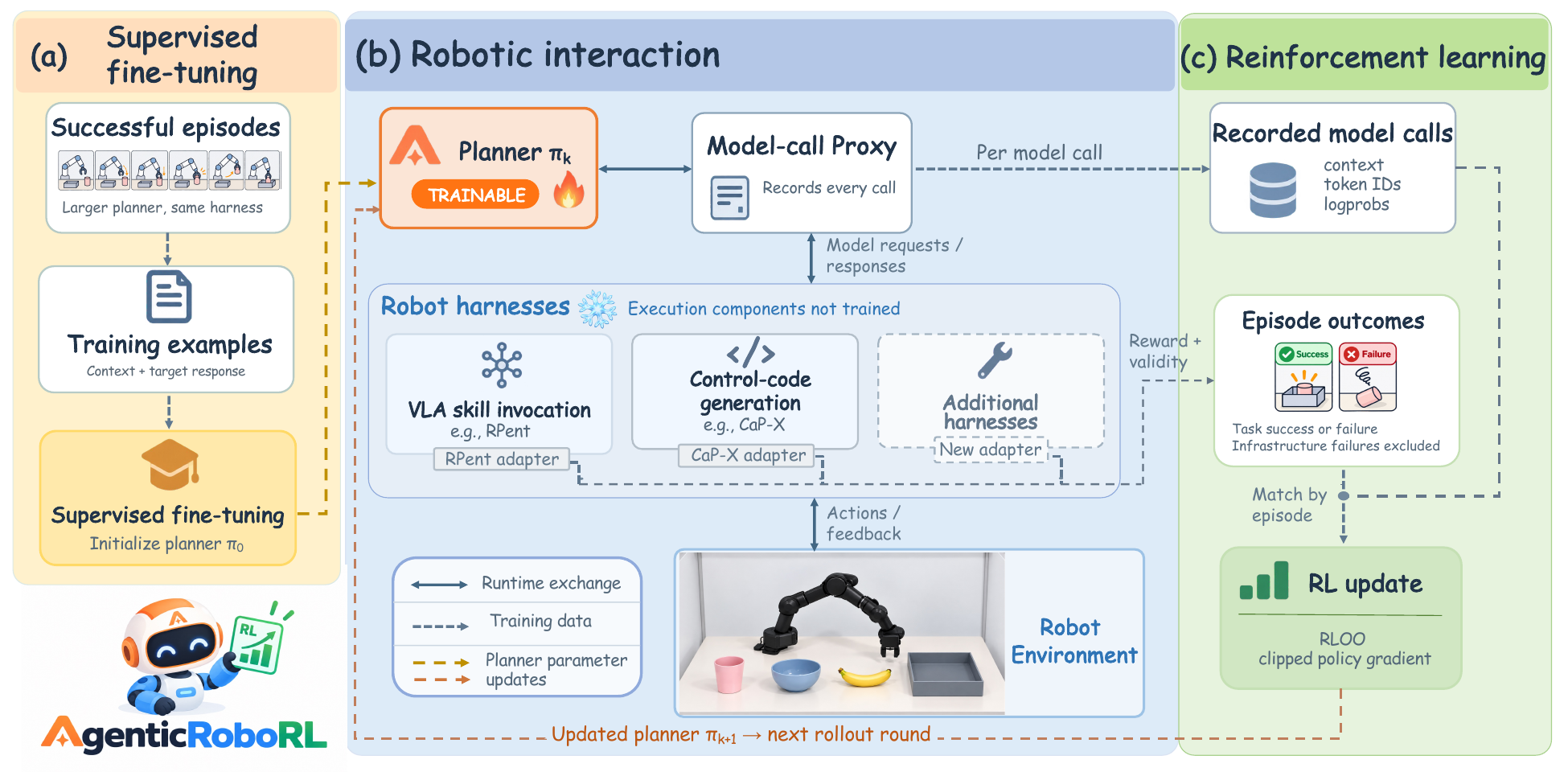
Harnesses
The planner calls skills
Perception tools locate objects. A frozen VLA policy executes pick skills, and motion tools move the arm. Evaluated on LIBERO-PRO and LIBERO-Plus.
segmentback_projectpi0_pickmove_toreleaseThe planner writes code
The planner writes executable programs over perception and control APIs, and a motion controller runs them. Evaluated on the Object, Goal, and Spatial suites of LIBERO-PRO.
pythonperception APIcontrol APIThe training pipeline does not depend on how a harness executes the planner. Connecting a new harness only needs a new adapter. We show two harnesses that execute plans in different ways.
Base vs. SFT vs. RL
Evaluation recordings, 256 × 256. Tool counts are taken from the planner's recorded calls. Single episodes are examples. Outcomes of individual episodes vary between repeated evaluations, so the 800-episode results below are the measure.
LIBERO-PRO by suite
T is task perturbation, S is position swap. 100 episodes per suite.
LIBERO-Plus, no extra training
10,030 episodes over seven perturbation types.
BibTeX
@article{liu2026agenticroborl,
  title   = {AgenticRoboRL: Bringing Coding-Agent
             Post-Training to Agentic Robotics},
  author  = {Liu, Xinxin and Xu, Bingxin and Bao, Wenrui and
             Li, Ming and Bao, Wentao and Chen, Chen and
             Shang, Yuzhang},
  journal = {arXiv preprint arXiv:2610.28589},
  year    = {2026}
}